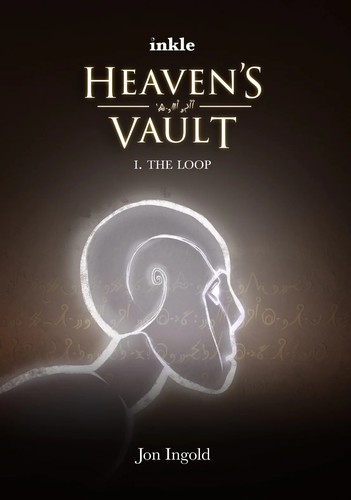
Kelson Reads a publié une critique de Heaven's Vault: I. The Loop par Jon Ingold
Another Path Through the Nebula
An archaeologist sails between "moons" in a habitable nebula linked by rivers. What starts as a simple quest to find a missing person ultimately reveals surprising truths about the history of the nebula and its people.
Aliya is determined, snarky, and has complicated relationships with the people of the poor moon she came from and the wealthy moon where she now lives. She's accompanied by a robot she calls Six, who manages to hold its own conversationally.
The books are based on the game of the same name, and the first two tell a story close to, but not quite the same as a play-through of the game. Side quests are left out, some incidents are rearranged, and flashbacks tell the story of El and Oroi exploring the decaying buildings of Elboreth as orphan children, and how Aliya found the Nightingale. You get to meet a couple …
An archaeologist sails between "moons" in a habitable nebula linked by rivers. What starts as a simple quest to find a missing person ultimately reveals surprising truths about the history of the nebula and its people.
Aliya is determined, snarky, and has complicated relationships with the people of the poor moon she came from and the wealthy moon where she now lives. She's accompanied by a robot she calls Six, who manages to hold its own conversationally.
The books are based on the game of the same name, and the first two tell a story close to, but not quite the same as a play-through of the game. Side quests are left out, some incidents are rearranged, and flashbacks tell the story of El and Oroi exploring the decaying buildings of Elboreth as orphan children, and how Aliya found the Nightingale. You get to meet a couple of her older robots, including the very talkative Three, and a (thematically appropriate) seventh robot from before Iox.
It's different enough from an actual playthrough that it still feels like you're experiencing something new if you've played the game, and tells a solid enough narrative that you don't need to have played the game to read them (though I imagine the target audience is mainly people who have).
Sailing the rivers is much more physical than the calm, flow-state experience in the game, more like actually sailing a small boat. Aliya strains muscles, the boat crashes into the occasional rock (and moon), she gets injured, the boat needs to be repaired.
The hieroglyphic-style Ancient writing is woven throughout the books. Fragments introduce some chapters, along with the numerals. Scene breaks use the glyph for separation.
The experience of actively translating is, well, translated to prose by showing Aliya and Six puzzling out the meaning based on how the glyphs combine. Some bits are translated completely, others partially, some left as extras for the reader. At one point in book three Aliya spends several pages trying to work out whether it's even possible to translate names from written Ancient to modern Ioxian or Elborethian, aside from the one name, Mazwai, that has survived the ages with context intact.
Occasionally a chapter is introduced with passages from Mazai's writings, credited here as being translated by Huang or Aliya.