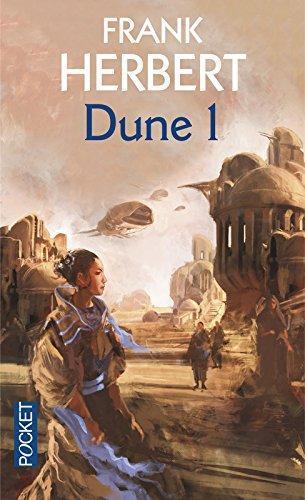
Il n'y a pas, dans tout l'Empire, de planète plus inhospitalière que Dune, partout des sables à perte de vue. Une seule richesse : l'épice de longue vie, née du désert, et que tout l'univers achète à n'importe quel prix. Richesse très convoitée : quand Leto Attréides reçoit Dune en fief, il flaire le piège. Il aura besoin des guerriers Frement qui, réfugiés au fond du désert, se sont adoptés à une vie très dure en préservant leur liberté, leurs coutumes et leur fois mystique. Ils rêvent du prophète qui …
Il n'y a pas, dans tout l'Empire, de planète plus inhospitalière que Dune, partout des sables à perte de vue. Une seule richesse : l'épice de longue vie, née du désert, et que tout l'univers achète à n'importe quel prix. Richesse très convoitée : quand Leto Attréides reçoit Dune en fief, il flaire le piège. Il aura besoin des guerriers Frement qui, réfugiés au fond du désert, se sont adoptés à une vie très dure en préservant leur liberté, leurs coutumes et leur fois mystique. Ils rêvent du prophète qui proclamera la guerre sainte et qui, à la tête des commandos de la mort, changera le cours de l'histoire. Cependant les Révérendes Mères du Bene Gesserit poursuivent leur programme millénaire de sélection génétique ; elles veulent créer un homme qui concrétisera tus les dons latents de l'espèce. tout est fécond dans ce programme, y compris ses défaillances. Le Messie des Fremen est-il déjà né dans l'Empire ?
2018 read: 5 stars because it was so interesting, but was a 1-star slog to get through.
2025 re-read: 5 stars on all fronts; guessing I was just not in the mood for this pacing the last time around. Loved so much about this book. Would re-read again now and excited to continue to the next books.
Det tok meg to måneder, men jeg kom meg gjennom. Originalen og Children var høydepunktene, og Messiah trekker scoren litt ned.
Disse bøkene kommer til å leve i hjernen min i mange år, og blir sannsynligvis lest igjen senere, når jeg har latt dem synke inn og jeg har fått lest God Emperor of Dune.
Men først skal jeg ta en liten ferie fra Arrakis og utforske nye verdener.
I wish I could give half-stars, because I probably would have given Dune a personal rating of 3.5/5.
I liked the story. I was able to fully immerse myself in the lore and the immaculate worldbuilding. And that was really something I have rarely seen anywhere else. I was contemplating whether to give this 3 or 4, but had to round up for the creativity in this area alone. I truly loved it.
My issue is mainly with the level of detail and the language. Some scenes are so excellently written that I felt like I was part of them, observing everything around me, noticing all the small things happening myself. Others, especially those concerned with Paul's inner conflicts, were almost excruciatingly abstract. And even though the language was beautiful throughout, I often found myself losing track in those sections (and, occasionally, genuinely having trouble understanding things linguistically, …
I wish I could give half-stars, because I probably would have given Dune a personal rating of 3.5/5.
I liked the story. I was able to fully immerse myself in the lore and the immaculate worldbuilding. And that was really something I have rarely seen anywhere else. I was contemplating whether to give this 3 or 4, but had to round up for the creativity in this area alone. I truly loved it.
My issue is mainly with the level of detail and the language. Some scenes are so excellently written that I felt like I was part of them, observing everything around me, noticing all the small things happening myself. Others, especially those concerned with Paul's inner conflicts, were almost excruciatingly abstract. And even though the language was beautiful throughout, I often found myself losing track in those sections (and, occasionally, genuinely having trouble understanding things linguistically, even with context – I didn't expect that it would encounter difficulties like that at all). Since those sections focused on Paul's interior are so crucial to Paul's development, and his development is, like, the main point of the book, I felt a bit lost, not really being able to trace how we'd gotten from the beginning to the end. I really only had this problem with Paul, not with any of the other characters. FWIW, Dune 2 (the movie) ended up having the same problem (to an even bigger extent, since the inner workings of Paul were not as exposed in it and the passing of time wasn't as clear).
I still think it was good - I just had a hard time with the main protagonist and that's why it failed to truly captivate me. Again, a lot (most) of it was really amazing. But it feels like I failed to grasp the entire thing, which is a bit sad. I'll probably continue reading the series at some point, though not sure when.
The first roughly two chapters were quite difficult to get into. Many terms I didn't understand, and I naturally didn't have a grasp of the political landscape, which would've been quite important to understand at the start. However, this feeling soon went away, as the situation became clearer.
I didn't like the story arc at all. The buildup was huge and monumental, but the resolution was frustratingly lame. Maybe this is only because this book is the first of a series, but still not satisfying.
What I really liked, was the world building. Instead of focusing on a technology-dominated future, Herbert forbid all AI-related machinery in his novel and instead focused on enhanced capabilities of humans. A concept that I'd say really worked out. The ecosystem of Arrakis is quite interesting too, as is the way of living of its inhabitants. And glimpses the reader gets into the …
The first roughly two chapters were quite difficult to get into. Many terms I didn't understand, and I naturally didn't have a grasp of the political landscape, which would've been quite important to understand at the start. However, this feeling soon went away, as the situation became clearer.
I didn't like the story arc at all. The buildup was huge and monumental, but the resolution was frustratingly lame. Maybe this is only because this book is the first of a series, but still not satisfying.
What I really liked, was the world building. Instead of focusing on a technology-dominated future, Herbert forbid all AI-related machinery in his novel and instead focused on enhanced capabilities of humans. A concept that I'd say really worked out.
The ecosystem of Arrakis is quite interesting too, as is the way of living of its inhabitants. And glimpses the reader gets into the politics, economy, and religion are also fascinating.
it took me ages to get through this. not because it's bad, probably mostly because i repaired my computer and had.. other things on my mind. but also partly because herbert's style reminds me of tolkien. like, a lot. at least in the sense that herbert really wants you to read his mediocre poetry too.
this isn't bad by any means, and i will surely read on in the future. probably around the time the second movie hits. the characters are fleshed-out and there's surprisingly little overt misogyny for a science fiction book that is, at this point, positively ancient. it's just the constant internal monologuing and then rushing through the actual happenings that gets exhausting after a while.