
Kristin Zourkas a publié une critique de Catherine's War par Ivanka Hahnenberger
Simple Writing with Powerful Illustrations, Character, and Themes!
4,0 stars
Catherine’s War by Julia Billet and Claire Fauvel is both a graphic novel and a historical fiction book that is guided toward teen readers. It received the Batchelder Award (2021), Youth Prize-Angoulême International Comics Festival (French edition), Artémisia Prize for Historical Fiction, Andersen Premio Prize, New York Public Library’s Best Books for Kids, Chicago Public Library Best Books for Kids, and is part of the Junior Library Guild Selection! The setting of this story takes place in France during World War II. When reading this story, it makes perfect sense why this book was converted into a graphic novel! The main character uses her love of photography to document her experiences. In many ways, photography is Catherine’s outlet that allows her to make sense of the world and share her unique lens/perspective. Photography also provides Catherine a sense of purpose and acts as a savior as she has to flee …
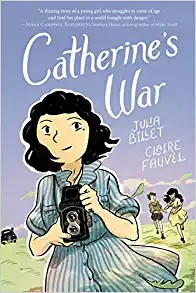
Catherine’s War by Julia Billet and Claire Fauvel is both a graphic novel and a historical fiction book that is guided toward teen readers. It received the Batchelder Award (2021), Youth Prize-Angoulême International Comics Festival (French edition), Artémisia Prize for Historical Fiction, Andersen Premio Prize, New York Public Library’s Best Books for Kids, Chicago Public Library Best Books for Kids, and is part of the Junior Library Guild Selection! The setting of this story takes place in France during World War II. When reading this story, it makes perfect sense why this book was converted into a graphic novel! The main character uses her love of photography to document her experiences. In many ways, photography is Catherine’s outlet that allows her to make sense of the world and share her unique lens/perspective. Photography also provides Catherine a sense of purpose and acts as a savior as she has to flee from one place to another in order to survive. I found the images in the novel to be both powerful and beautiful to the storyline of the book. The illustrator Claire Fauvel uses different tones of color depending on the mood of the story. At times when Catherine is in danger, Fauvel will use darker shades whereas times when Catherine feels safe she will use warm hues for contrast. In many ways, there is visual storytelling in addition to the story itself. There were many graphics that also highlighted characters that faced amputation from the war. The graphic also help show the constant movement that Catherine undergoes when being misplaced from the war. The author Julia Billet discusses the heavy topic of the Holocaust and World War II for teenagers in a way that makes it accessible to them. The protagonist is roughly the same age as the target audience for this graphic novel. The main character Catherine is really a Jewish girl named Rachel Cohen. At the beginning of the novel, it explains how Rachel’s life changed when the Nazis occupied France. Rachel developed a passion for photography at “The Sevres Children’s Home” until it became clear with more Nazis occupation that she and others at the children’s home that were Jewish would have to take on a fake identity to survive. Rachel became “Catherine Colin”. When reading, I felt Catherine’s fear and uncertainty of the war. It involves a plot where she is fleeing from one place to the next and hiding her true identity in order to not be captured by the Nazis soldiers. I found a lot of messages and themes when reading this powerful novel. Despite Catherine experiencing fear and uncertainty, she also had a sense of resilience and strength through her photography and journey. She found purpose in taking her photos and helping children in similar situations. Catherine kept her hope during the war. She hoped to see her parents again, hoped to see her love interest Etienne again, and hoped to see Alice again. The biggest theme was one of identity. Rachel had to become “Catherine” and strip away her Jewish roots in order to survive. She had to take on a completely new identity. Since Julia Billet uses simple structure in her book with powerful images, I think this would be easily accessible to middle school-high school students. I think this graphic novel would be best used to introduce students to the Holocaust and Anti-Semtism. I also think it would be powerful to highlight the themes of hope and displacement from a war. If a teacher wanted to have students read this for a non-historical purpose, I think it would be great for an illustration study to compare plot to tones/shades of color used in the graphic. Another way to implement this novel for instruction would be to focus on the themes of identity. Many adolescent-young adults struggle with a sense of identity at that time in their lives. I found this to be a very inspiring story and otherwise easy read for addressing heavy topics of World War II!