Jarjan a publié une critique de Walkaway par Cory Doctorow
A fantastic read!
5,0 stars
I really don;t know what to write about this book, a lot has already been written I'm sure. All I can say is: It's great, read it,
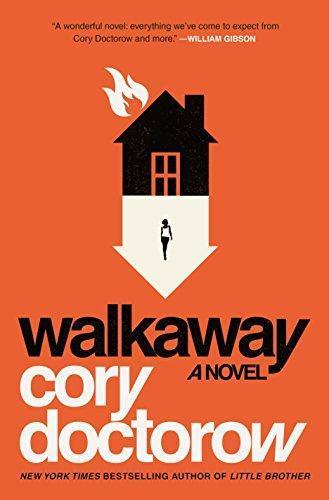
Walkaway is a 2017 science fiction novel by Cory Doctorow, published by Head of Zeus and Tor Books. Set in our near-future, it is a story of walking away from "non-work", and surveillance and control by a brutal, immensely rich oligarchical elite; love and romance; a post-scarcity gift economy; revolution and eventual war; and a means of finally ending death.
384 pages
Langue : English
Publié 17 juin 2017 par Tor Books.
I really don;t know what to write about this book, a lot has already been written I'm sure. All I can say is: It's great, read it,
« Le grand abandon » est un roman d’anticipation qui se déroule dans un futur proche où, sans surprise, les crises actuelles se sont aggravées : le monde est ravagé par le changement climatique, les inégalités sociales ont continué d’exploser, tout comme le chômage et la précarité, alors même qu’une fraction de la population s’arrogeait l’essentiel des richesses… Dans ce monde peu réjouissant (mais pas si différent du nôtre), un phénomène se développe : les « abandonneurs ». Être abandonneur, c’est refuser les règles établies, les considérer comme obsolètes… et donc tout abandonner pour tourner le dos au « monde par défaut » (celui qu’on nous impose en nous faisant croire qu’il n’y a pas d’alternatives) pour imaginer d’autres manières de vivre, de s’organiser, de travailler… de faire société.
Le roman suit une poignée de personnages abandonneurs, assez attachants au demeurant, même s’ils servent surtout de prétextes pour faire …
« Le grand abandon » est un roman d’anticipation qui se déroule dans un futur proche où, sans surprise, les crises actuelles se sont aggravées : le monde est ravagé par le changement climatique, les inégalités sociales ont continué d’exploser, tout comme le chômage et la précarité, alors même qu’une fraction de la population s’arrogeait l’essentiel des richesses… Dans ce monde peu réjouissant (mais pas si différent du nôtre), un phénomène se développe : les « abandonneurs ». Être abandonneur, c’est refuser les règles établies, les considérer comme obsolètes… et donc tout abandonner pour tourner le dos au « monde par défaut » (celui qu’on nous impose en nous faisant croire qu’il n’y a pas d’alternatives) pour imaginer d’autres manières de vivre, de s’organiser, de travailler… de faire société.
Le roman suit une poignée de personnages abandonneurs, assez attachants au demeurant, même s’ils servent surtout de prétextes pour faire découvrir aux lecteurs la vie de plusieurs communautés d’abandonneurs, et les inévitables frictions que cela engendre avec le monde par défaut.
Comme beaucoup (le livre est chaudement recommandé par William Gibson, par Edward Snowden et par Kim Stanley Robinson), j’ai beaucoup apprécié ma lecture, pas tant pour l’histoire elle-même que pour les réflexions passionnantes qu’elle suscite en rappelant que la technologie n’est qu’un moyen, mais que la manière dont on l’utilise, ce sont des choix et qu’ils nous concernent tous, et mériteraient une plus grande mobilisation de tous.
J’avais déjà lu un premier roman de Cory Doctorow, Little Brother, qui questionnait la dérive sécuritaire associée aux outils de surveillance de masse déployés sous couvert de la lutte anti-terroriste (et donnait envie de soutenir La Quadrature du net). « Le grand abandon » est plus ambitieux et s’attaque à l’organisation même de nos sociétés. Il remet en cause l’ultralibéralisme, mais sans tomber dans le communisme ou l’anarchisme pour autant. C’est plus geek et plus intéressant que cela. Dans ses influences, Cory Doctorow cite d’ailleurs à la fois l’économiste Thomas Piketty et l’anthropologue David Graeber (qui est aussi un militant anarchiste). Les abandonneurs sont manifestement les héritiers des différentes associations, organisations, mouvements et collectifs actuels qui travaillent sur les notions de bien commun, de justice sociale, de démocratie réelle, d’horizontalité, etc. Ce sont les enfants des militants de l’opensource mais aussi ceux des militants qui font converger les luttes écologiques, sociales et politiques. Ça donne toujours envie de soutenir la Quadrature… mais aussi tant d’autres mouvements et collectifs ! Ça donne de l’espoir, et ça redonne envie de prendre part au mouvement… ce qu’Edward Snowden résume très bien :
Cette histoire nous rappelle que nous vivons dans le monde que nous avons de choisi de bâtir. La technologie fournit des moyens aux puissants comme aux autres, et si nous voulons une société moins surveillée et plus de liberté, il va falloir lutter pour la créer.
Qué rabia los libros que sabes que tendrían que haberte encantado y que te llegan en un momento complicado que no te permite dedicarles la atención que merecen. Este libro está lleno de ideas poderosísimas y me resonaba a muchos niveles. Pero he tardado mucho en leerlo porque apenas he podido sacar tiempo para él. Las veces que he podido me enfrascaba en él y devoraba las páginas. Pero luego igual se me juntaba una semana sin abrirlo. Y es una lástima, porque el mundo utópico/distópico que plantea es interesantísimo y un tanto aterrador por lo plausible que resulta. Una gran novela de ciencia ficción que me ha llegado en el peor momento. Una pena.
Walkaway by @pluralistic@mamot.fr has been described as a utopian novel in a sea of dystopian alternatives, although I'd say it's actually both utopian and dystopian. It takes place in the 'middle distance' of the future; cars are still a thing, and they have wheels that roll on the ground, space travel isn't really a thing yet - humankind is essentially still bound to the Earth. But number of current-day issues have reached their logical culmination; from mundane technology (drones everywhere, 'interface surfaces' stuck to things instead of touch-screen smartphones, 3D printer 'fabs' are ubiquitous, capable of printing machines, clothing, and food) to the Big Issues of our time: Social inequality is extreme, with the overwhelming majority of the populous trapped in a struggling middle-class of insecure wage slaves, ruled by a tiny over-class of 'zottas', the hyper-rich owners of everything, from real estate, through business and roboticized industry, to intellectual …
Walkaway by @pluralistic@mamot.fr has been described as a utopian novel in a sea of dystopian alternatives, although I'd say it's actually both utopian and dystopian. It takes place in the 'middle distance' of the future; cars are still a thing, and they have wheels that roll on the ground, space travel isn't really a thing yet - humankind is essentially still bound to the Earth. But number of current-day issues have reached their logical culmination; from mundane technology (drones everywhere, 'interface surfaces' stuck to things instead of touch-screen smartphones, 3D printer 'fabs' are ubiquitous, capable of printing machines, clothing, and food) to the Big Issues of our time: Social inequality is extreme, with the overwhelming majority of the populous trapped in a struggling middle-class of insecure wage slaves, ruled by a tiny over-class of 'zottas', the hyper-rich owners of everything, from real estate, through business and roboticized industry, to intellectual property - Thomas Picketty's "Capital in the 21st Century" taken at its word. In addition, climate change has raised sea levels, flooding major cities, and pollution has rendered others unlivably toxic - great swathes of civilisation lie abandoned and in ruins.
At this intersection of technological advancement an eco-social catastrophe, three initial protagonists, Hubert, Seth, and Natalie decide to become "walkaways", joining a 'post scarcity' movement that rejects the premises of the materialistic, hierarchical, and clearly unsustainable "default" civilisation they find themselve in, and, rather than resisting or trying to change it, they simply 'walk away', leaving behind possessions, the very idea of ownership, money, work, and social status. The walkaways have no formal structure or organisation, are simply a collection of people living ideologically and literally outside civilisation. They occupy abandoned land and using 'fabbers', FAQs, and software, construct machines, buildings, and everything else they need, using 'feedstock' scavenged from the surroundings. Designs and systems are open-sourced and constantly improved on by whoever wants to work on them. Similarly work that needs doing on their pop-up settlements, from construction to food preparation, is picked up by whoever wants to do it, helped and highlighted by ubiquitous smart technology, all powered by wind and sun.
The trio wander and learn the walkaway terrain, make friends and lovers, with imminent disaster always looming - from internal philosophical conflicts and power struggles to increasingly lethal incursions from the "default" world, which sees the walkaways as more and more of an existential threat. They discover a community of scientists working on the ultimate act of walking away - the abandonment of biological dependency; developing the means to 'scan' the important parts of a person from their neurological structure, and 'sim' them on a digital substrate - i.e. upload minds into computers, making not only material but also temporal scarcity irrelevant. The walkaways want to eliminate death, and they want to open-source it so that everyone, not just the zotta overlords, can enjoy the benefits of disembodied immortality.
As so much good science fiction is, the novel is essentially a vehicle for Doctorow to explore philosophical ideas and take them to logical conclusions. Much of the dialogue is essentially 'Socratic'; two or more characters ostensibly 'arguing' about something, as a means for the author to explore a particular set of opposing philosophical positions. The topics are wide-ranging. 'Open-source' development and organisation feature large in the walkaway world; putative meritocracies are examined through a couple of different lenses: the zotta's, personified by Natalie's father, believe themselves to have floated to the top of society by their own genius, rather than their privilege, but also the walkaways themselves debate about their own social organisation, and whether work gets done more efficiently when 'merit' is rewarded by formal kudos or by the privilege of having exclusive right to particular work. In a nice twist, those with merit are labelled 'snowflakes', an epithet currently reserved for 'bleeding-heart liberals' by the 'right' in the real world, but used in Doctorow's world to apply to decidedly right-wing capitalists and others who feel their talents grant them divine rights not shared with commoners.
The 'mind-brain' problem (complete with oriental room), of course, is given an airing, along with some discussion of the possible socio-political consequences of widespread immortality. Interestingly, although mass abandonment of biology, and social control via fear becoming impossible, are projected as the outcome of mind-uploading, these scenarios don't actually play out in the novel, and the reasons aren't directly explicated.
However, rather than have the characters duke out all the issues raised, some of them are simply 'givens' in the walkaway universe; economic inequality, the militarised police state, anthropogenic environmental catastrophe. The injustices of these have terrible consequences in the story, but they're not 'solved' by it, and this is the dystopian facet of the work. Its utopia, on the other hand, is represented by ascent of the walkways, from an underground, marginal movement, through increasing persecution as their numbers and relevance swell, to finally (and possibly too sweetly) they become the 'default' themselves, by sheer force of numbers (and of course the efficiency, justice, and 'rightness' of their way of life).
Along the way, there are lots of opportunities to explore both neat and terrible technology, including realistic extrapolations from the state of the art, and actually real (if currently less ubiquitous) things, some interesting uses, and drawbacks to, #cryptography, changes of social norms around drugs, sexuality, gender, and race. And Doctorow gets to air many of his memes - individuals failing to recycle their way out of global warming; only those who tread water against all odds surviving shipwrecks, economists being to the 1% as court astrologers were to kings...
For me it was just the right mix of the familiar with some new ideas; allowing this reader to both feel like he knows some things, but also have some new thoughts too. I imagine it would be a vindicating romp for faraday-cage-wallet-toting, gait-altering, #cyanogenmod-installing, #cypherpunk githubbers everywhere.
The only thing wrong with it is that you can't put it down. Not even if it's 3am. This is why I can't read novels - they're the original Netflix binge-watching recipe for sleep deprivation.
i really wish someone got Doctorow an editor and deleted the sex scenes