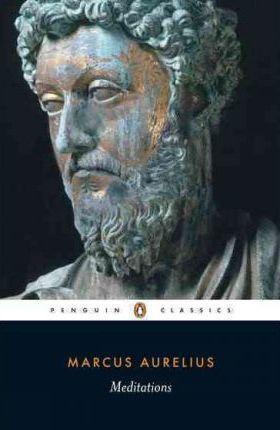
Meditations (Medieval Greek: Τὰ εἰς ἑαυτόν, romanized: Ta eis he'auton, lit. 'things to one's self') is a series of personal writings by Marcus Aurelius, Roman Emperor from AD 161 to 180, recording his private notes to himself and ideas on Stoic philosophy. Marcus Aurelius wrote the 12 books of the Meditations in Koine Greek as a source for his own guidance and self-improvement. It is possible that large portions of the work were written at Sirmium, where he spent much time planning military campaigns from 170 to 180. Some of …
Meditations (Medieval Greek: Τὰ εἰς ἑαυτόν, romanized: Ta eis he'auton, lit. 'things to one's self') is a series of personal writings by Marcus Aurelius, Roman Emperor from AD 161 to 180, recording his private notes to himself and ideas on Stoic philosophy.
Marcus Aurelius wrote the 12 books of the Meditations in Koine Greek as a source for his own guidance and self-improvement. It is possible that large portions of the work were written at Sirmium, where he spent much time planning military campaigns from 170 to 180. Some of it was written while he was positioned at Aquincum on campaign in Pannonia, because internal notes tell us that the first book was written when he was campaigning against the Quadi on the river Granova (modern-day Hron) and the second book was written at Carnuntum.
It is unlikely that Marcus Aurelius ever intended the writings to be published. The work has no official title, so "Meditations" is one of several titles commonly assigned to the collection. These writings take the form of quotations varying in length from one sentence to long paragraphs.
Ces Pensées, non destinées à être publiées, se lisent avec plus ou moins de facilité. Beaucoup d'aphorismes, parfois redondants, paraissent assez simples à comprendre, et certains d'entre eux peuvent évoquer des concepts que l'on retrouve dans la philosophie orientale (je pense à des notions comme l'impermanence). Cela donne l'impression que la réflexion peut mener à des principes universels (des conseils similaires prescrits à travers les âges dans des zones géographiques éloignées). D'autres réflexions sont bien plus obscures, mais, profane, je me suis autorisé une lecture légère, ne faisant qu'effleurer le texte. Je ne me permettrai donc aucune réflexion sur le fond, n'ayant pas du tout les compétences et connaissances nécessaires à une lecture sérieuse et éclairée d'un texte écrit il y a 19 siècles :-)
It's difficult to review a book that has been read by many thousands or millions of people over the past two thousand years or so, including world leaders, philosophers and other academics, athletes, and everyday people who just want to live their best lives possible. Meditations by Marcus Aurelius, Emperor of Rome (161-180), was never intended to be read by anyone other than its author. It is a collection of Aurelius' thoughts as they occurred to him, presumably over the course of his life. This book has no plot, no story arc, and no relatable characters, per se. Instead, it's a record of his daily journal that has been translated, interpreted, and transcribed repeatedly down through the ages. The individual entries have been compiled into 12 books, which are loosely arranged in chronological order; although there is some debate about that.
This book is remarkable for two important …
It's difficult to review a book that has been read by many thousands or millions of people over the past two thousand years or so, including world leaders, philosophers and other academics, athletes, and everyday people who just want to live their best lives possible. Meditations by Marcus Aurelius, Emperor of Rome (161-180), was never intended to be read by anyone other than its author. It is a collection of Aurelius' thoughts as they occurred to him, presumably over the course of his life. This book has no plot, no story arc, and no relatable characters, per se. Instead, it's a record of his daily journal that has been translated, interpreted, and transcribed repeatedly down through the ages. The individual entries have been compiled into 12 books, which are loosely arranged in chronological order; although there is some debate about that.
This book is remarkable for two important reasons. It provides a glimpse into the thoughts of a Roman emperor, and it defines his personal life philosophy. Aurelius was a student of Stoic philosophy, which he carried with him throughout his life. Meditations represents his version of Stoic philosophy as he applied it to his own life. It's this philosophy that informed his approach not just as a ruler, but also as a human being. The philosophical virtues that were important to Aurelius and other ancient Stoic philosophers transcend time and are just as applicable today as they were back then.
This is not a book to be read once and returned to the shelf to collect dust. It's meant to be read slowly and repeatedly; it's meant to be studied. I found myself often reflecting on individual passages while I searched for ways these ideas were relevant to me and my own circumstances. I've only read this book once, but it's clear to me that new revelations are likely to emerge with each subsequent reading. Very few books can maintain their relevance beyond a few decades, let alone centuries or millennia. But this one does. This is one book to which I will return often as I polish my own personal philosophy, as so many have done before me.