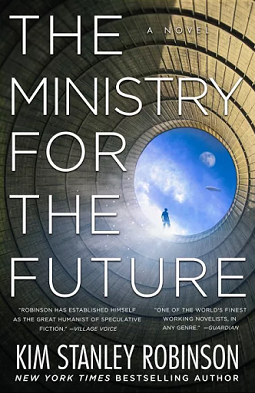

zemoko a publié une critique de Le Ministère du futur par Kim Stanley Robinson
Un roman bienvenu. Réaliste et étayé.
5,0 stars
Au début des années 2000, j’avais adoré la Trilogie Martienne de Kim Stanley Robinson qui racontait la colonisation de Mars (et qui, soit dit en passant, a inspiré le jeu Terraforming Mars).
Quelques années plus tard (en 2008 genre), j’avais également beaucoup aimé sa Trilogie Climatique qui relatait, déjà, les impacts du changement climatique. C’est dire si j’attendais avec impatience ce nouveau roman !
L’histoire de The ministry for the future commence au début des années 2020. Une vague de chaleur hors-norme s’abats sur l’Inde, faisant 20 millions de morts en à peine une semaine. Le premier des protagonistes que l’on suivra, Franck May, est un humanitaire américain qui y survit, de justesse et avec de sévères troubles post-traumatiques.
Ce n’est qu’une introduction car le changement climatique est en marche. Le constat à faire sur l’Accord de Paris est sans appel : les objectifs que se sont …
Au début des années 2000, j’avais adoré la Trilogie Martienne de Kim Stanley Robinson qui racontait la colonisation de Mars (et qui, soit dit en passant, a inspiré le jeu Terraforming Mars).
Quelques années plus tard (en 2008 genre), j’avais également beaucoup aimé sa Trilogie Climatique qui relatait, déjà, les impacts du changement climatique. C’est dire si j’attendais avec impatience ce nouveau roman !
L’histoire de The ministry for the future commence au début des années 2020. Une vague de chaleur hors-norme s’abats sur l’Inde, faisant 20 millions de morts en à peine une semaine. Le premier des protagonistes que l’on suivra, Franck May, est un humanitaire américain qui y survit, de justesse et avec de sévères troubles post-traumatiques.
Ce n’est qu’une introduction car le changement climatique est en marche. Le constat à faire sur l’Accord de Paris est sans appel : les objectifs que se sont fixés les États signataires, pourtant notoirement insuffisants, ne sont jamais atteints. En conséquence, les catastrophes se succèdent tandis que que le business as usual perdure.
Le titre du roman, c’est le nom de cette nouvelle institution créée pour dépasser ce constat. Partant du principe que le changement climatique a un impact direct sur les générations futures. Elles sont sont donc lésés, sans jamais être représentées politiquement. La mission du Ministère du futur sera donc de les représenter. Le second protagoniste du roman, Mary Murphy, est la première à endosser le poste de Ministre du futur.
D’abord passablement impuissant, on verre le Ministère gagner en importance et en influence pendant les 30 années que couvre le roman.
Comme d’habitude (pour les romans de Kim Stanley Robinson), c’est un roman très documenté et parfaitement crédible. Catastrophes climatiques, érosion de la biodiversité, réfugiés climatiques… le roman traite autant de sciences dures que de sciences molles.
On y croise d’autres points de vue que ceux de Franck et de Mary, notamment des mouvements citoyens radicalisés, les Enfants de Kali, qui s’en prennent aux milliardaires, aux centrales à charbon, aux avions de lignes, etc. C’est une évolution qui m’a fait penser au livre « How to blow up a pipeline » d’Andreas Malm qui s’étonnait que la crise climatique n’ait pas encore entrainé plus de radicalisation et soutenait que le sabotage est une forme logique d’activisme climatique. On notera d’ailleurs que Badim, le chef de cabinet de Mary, gère une division occulte du ministère qui assume de faire appel à des moyens violents pour permettre au Ministère d’atteindre ses objectifs.
C’est un roman bienvenu, car il décrit parfaitement bien la catastrophe en cours, et le peu de réactions des pouvoirs politiques et économiques, mais c’est aussi un roman optimiste car Kim Stanley Robinson mise sur le fait qu’entre radicalisation écologique (ce qui est donc aussi la thèse d’Andreas Malm) et nouveaux modèles inventés par différents pays du Monde (dont l’Inde, traumatisée par la vague de chaleur mortelle qu’elle a subie), l’humanité va réussir à stabiliser puis inverser le changement climatique.
C’est réaliste, et étayé. De multiples solutions sont en effet décrites, et appliquées : géo ingénierie, agriculture régénératrice, projets pharaoniques pour ralentir la fonte des pôles, avions et bateaux neutres en carbones. C’est intéressant… mais j’ai mes doutes. Je trouve certaines technologies, même si c’est de la fiction et même si on considère que ce serait en 2050, trop proches du technosolutionnisme de certains… Technosolutionisme que je trouve dangereux. Je suis perplexe notamment sur la possibilité d’avoir des avions qui pourraient devenir neutres…
Mais c’est presque sur le plan politique que j’ai eu le plus de doutes. L’un des points de bascule vient d’une idée du Ministère, une crypto monnaie carbone garantie 100 ans par les principales banques centrales. Le roman montre la difficulté à porter cette idée et à la faire aboutir, ce n’est pas le problème… mais il y arrive… Je dois être désabusé mais j’ai beaucoup de mal à imaginer que ces organisations puissent céder sur un tel projet, même difficilement.
Cela reste néanmoins un très grand roman que j’ai beaucoup apprécié et que je conseille fortement. Il pose impeccablement le problème et propose une réflexion détaillée, et a le mérite de traiter aussi de solutions au problème climatique (je retiens, pour ma part, la nécessité d’une radicalisation si on veut faire bouger les choses…).